
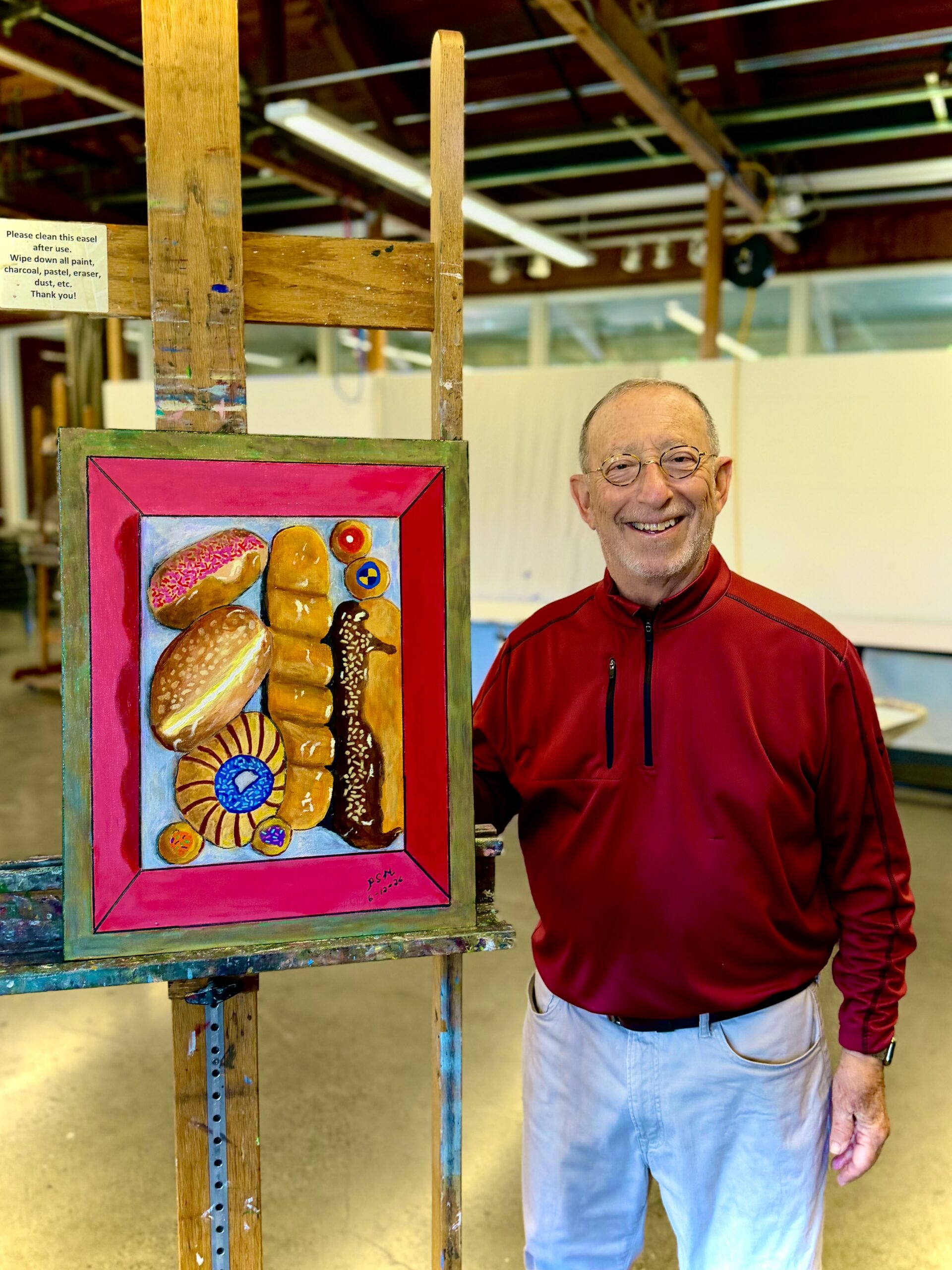
 How Vivid Colors Helped Me Rediscover Joy, Purpose, and Resilience
For 41 years, I worked as a diagnostic radiologist, spending much of my professional life in darkened hospital reading rooms, staring at the endless shades of gray in medical images.
The work became increasingly demanding. The volume and complexity of studies grew, along with RVU pressures and the relentless expectations of modern medicine. Little by little, there was less time for myself, for my family, and for exploring anything outside of medicine.
I became chronically irritable, frustrated, impatient, and emotionally exhausted. I withdrew from people I loved. I felt spiritually bankrupt. I was in deep burnout. And I remained stuck in the doldrums of burnout for a very long time.
Eventually, my struggles began affecting my relationships with my children, and my marriage. That got my attention. I could no longer deny what was happening. I knew I had to make a meaningful change.
With the wisdom, encouragement, and support of many others and my family, I made a dramatic mid-career transition into physician coaching. The training took two years because I was still working clinically full-time. Becoming a coach changed my life—and, in many ways, saved my mind and spirit.
I took a risk and reduced my clinical work at Stanford Radiology to half-time while building my career as a life and career coach for physicians. Coaching allowed me to become more authentic: insightful, empathic, and kind. I found greater meaning and purpose in my daily work and more time for professional growth, family, friends, and the activities I loved.
Eventually, I retired from radiology.
My coaching practice was thriving. I was writing, speaking, teaching, and finding deep satisfaction in helping other physicians navigate their careers and their lives.
Yet something was still missing. I felt incomplete. I knew I needed a new challenge—something completely different. Something that would stretch me in a new direction.
Then, in January 2024, I saw a small advertisement in my local newspaper:
“Acrylic Painting for Beginners.” Something inside me said, Take the class.
So I did.
I had never taken an art class. I had no recognizable artistic talent. I had no idea what I was doing.
And that decision unexpectedly opened an entirely new chapter of my life.
THE SURPRISE: I DISCOVERED I COULD PAINT
Over the past two years, I have experienced a remarkable awakening of a previously hidden part of myself.
I discovered that I could draw. I could make pencil sketches. I could mix and blend acrylic paints. I could experiment with color, texture, light, shadow, and dimension. And, most surprisingly of all, I discovered that I was actually pretty good at it.
Who knew?
Each painting presented a new challenge and forced me to develop new skills. I became fascinated by vivid colors—a joyful antidote to the endless grayness of medical imaging.
And then I realized something else.
Many of the skills I had developed over four decades as a radiologist were helping me as a painter. I instinctively understood shadows, three-dimensional space, perspective, form, and subtle variations in tone. My years of looking carefully at medical images had trained my eyes in ways I had never appreciated.
Slowly, almost without realizing it, I became a painter. And painting began changing much more than my artistic abilities.
It began changing me.
WHAT PAINTING HAS GIVEN ME
Painting has brought me joy, peace, greater self-esteem, and a renewed sense of curiosity. It has helped reduce my stress and improve my mood. The intense concentration required while painting creates a kind of peaceful stillness and focus that reminds me of meditation.
For those hours, there is no RVU pressure, no medical inbox, no patient list, no deadline.
There is simply the canvas.
The color.
The brush.
The moment.
Painting has also strengthened my resilience. It has taught me to experiment, make mistakes, step back, reconsider, and try again. A painting rarely turns out exactly as I imagined it. I have learned to tolerate uncertainty and trust the process.
Those are useful lessons far beyond the art studio.
Painting has also changed the way I experience the world. Going to an art museum is an entirely different experience for me now. I am no longer simply looking at a painting and deciding whether I like it.
I want to get closer.
How did the artist create that shadow? How were those colors mixed? Why is the paint thick in one area and thin in another? How did the artist create that sense of depth?
I am curious in a way I never was before.
And curiosity may be one of the greatest gifts of creativity.
WHAT PHYSICIANS CAN LEARN FROM THIS
Physicians today are experiencing extraordinary levels of dissatisfaction, burnout, emotional exhaustion, and moral injury. Despite individual efforts at self-care, the growing number of institutional wellness programs, and institutional efforts to improve the culture of medicine, the stresses of practicing medicine remain enormous.
As a physician coach, I have spent decades writing, speaking, and coaching about strategies for dealing with those stresses.
Today, I tell my physician clients something I wish I had understood much earlier:
Consider creativity as part of your self-care plan.
We readily accept the idea that physical exercise is essential for our health. We go to the gym to improve cardiovascular fitness, muscle strength, flexibility, and reduce our stress. And we understand that consistency matters. The more repetitions you do, the stronger you become.
Why not apply the same principle to creativity?
You don’t need experience.
You don’t need artistic talent.
You don’t need to produce something worthy of a museum.
I am living proof.
What you do need is curiosity, a willingness to be a beginner, and the courage to try something unfamiliar.
The goal isn’t to become a great artist.
The goal is to become more resilient, happier, more self-aware, more present, and more curious about life.
Painting is only one possibility. You might try photography, music, writing, pottery, woodworking, gardening, dance, knitting, cooking, or any other creative activity that stimulates your senses and captures your imagination.
The specific activity doesn’t matter nearly as much as the act of creating.
TAKE THE LEAP
For years, I believed that my identity and destiny were largely defined by medicine.
Then coaching opened another door.
Painting opened still another.
And I discovered that there were parts of myself I had never given permission to explore.
That may be the most important lesson of all.
Sometimes we don’t need another wellness lecture, another productivity strategy, or another prescription for managing stress.
Sometimes we need to do something completely different.
Something that makes us curious.
Something that makes us feel alive.
Something where we are willing to be a beginner again.
So if there is an art class you’ve been thinking about taking, take it.
If there is a creative activity you’ve always wanted to try, try it.
Take the leap!
You may discover a talent you never knew you had.
But even more importantly, you may discover a new part of yourself.
I did.
And I found something I had been missing for a very long time: Vibrant Color!